

- Case Study One
- Case Study Two
- Case Study Three
- Case Study Four
- Case Study Five
- Case Study Six
- Case Study Seven
- Case Study Eight
- Case Study Nine
- Case Study Ten
Case Study One
Easy-to-Use, Secure Ticketing & Attendee Management for Nachural, UK
Solution provided by Mind & Matter: Complete design and development
Overview:
Nachural, a UK-based organisation renowned for hosting premier black-tie and red-carpet business events, needed an all-integrated and easy-to-use ticketing solution that can seamlessly handle all aspects of an event. The goal was to develop a platform that simplifies event operations—enabling effortless ticket purchases, secure digital validation, and real-time attendee tracking. The result is a streamlined, secure, and efficient system that enhances the overall experience for both organisers and guests.
Challenges:
Hosting high-profile business events came with several operational hurdles, requiring a seamless, secure, and efficient ticketing system. Nachural Events faced key challenges, including:
- Lack of a Scalable and easy Registration System – Registering and Managing large volumes of attendees efficiently without technical bottlenecks.
- Complex identification & attendee validation – Difficulty in ensuring quick, fraud-proof check-ins while maintaining data security.
- High-Cost, Rigid Solutions – Existing options lacked flexibility, making it challenging to adapt to event-specific needs.
- Poor Customer Support and Attendee Experience – Inefficient processes lead to delays and impact the overall event experience.
A significant amount of time was spent manually tracking ticket purchases and attendee check-ins on event days.
To overcome these challenges, Nachural Events needed a partner capable of delivering a high-performance, scalable technology solution that matched their reputation for excellence.
Solution:
Mind & Matter developed an end-to-end ticketing platform tailored to Nachural’s needs. The system featured:
- Angular-Based Web Platform – A responsive interface for users to purchase tickets, manage bookings, and access event details.
- QR Code Generation & Validation – Every ticket included a unique, encrypted QR code, ensuring secure and contactless check-ins.
- Admin Dashboard – Organisers could manage events, track ticket sales, and generate insights via a powerful backend.
- Mobile QR Scanner App – A dedicated application for real-time ticket validation at event entrances.
- Secure Payment Gateway – Integrated Stripe and PayPal for seamless, multi-currency transactions.
Nachural Events now seamlessly manages ticketing for its events, eliminating complexities and time-consuming processes—from ticket sales to attendee check-ins on the event day.
Technology Stack:
- Frontend: Angular, TypeScript
- Backend: Node.js, Python
- Database: MongoDB/PostgreSQL
- QR Scanner: Flutter/React Native
- Hosting: AWS/GCP/Azure
Security Measures:
- Encrypted QR Codes – Preventing duplication and fraud.
- Role-Based Access Control – Restricting access based on user roles.
- GDPR Compliance – Ensuring user data protection and privacy.
Outcomes:
- Streamlined Event Entry – Faster check-ins reduced queues and improved guest experience.
- Secure Transactions – Multi-layer security ensures safe online payments.
- Automated Ticket Management – Real-time reporting and tracking provided organizers with complete control.
- Scalable Infrastructure – The system efficiently handled high traffic during peak sales and event days.
- Fast & Mobile-Friendly – The platform works seamlessly on any mobile device, allowing organisers and attendees to manage tickets and check-ins effortlessly from anywhere, anytime.
Conclusion:
By leveraging cutting-edge technology, Mind & Matter delivered a seamless, secure, and efficient ticketing system tailored for Nachural’s events. The platform not only improved operational efficiency but also enhanced attendee satisfaction, setting a new standard for event ticketing.
Mind & Matter: Your go-to digital transformation partner for all businesses
When innovation meets execution, excellence follows
We are proud to have partnered with Nachural to design a seamless, secure, and scalable ticketing and attendee management platform—built to power world-class events with speed, security, and simplicity. Explore how Mind & Matter transforms challenges into success stories.
#DigitalTransformation #EventTech #Innovation #MindAndMatter
Case Study Two
Building a Comprehensive and Engaging Global Learning Platform for Union Education Group (UEG)
Overview:
Union Education Group (UEG), a global holistic education platform offering bespoke 1:1 tuition, live and pre-recorded courses for all academic subjects and skill courses partnered with Mind & Matter to build a dynamic educational portal that bridges the gap between learners and their access to world-class resources. The focus was crafting a scalable and immersive digital portal where users can easily join live courses, interact with educators, and dive into an expansive knowledge hub tailored to their needs.
Challenges:
Building a dynamic, user-friendly and engaging platform required addressing several unique challenges to align with UEG's vision of global reach and inclusivity.
- Engaging Learning Experience: UEG sought a responsive platform to guide users through academic, skill-based, and well-being courses. The challenge lies in understanding the diverse needs of the users and offering personalised recommendations.
- Real-Time Learning Integration: Seamless live courses, categorised by learning goals and integrated with educator profiles for insights into course details and outcomes.
- Scalability and Performance: With UEG’s rapid expansion plans, the platform needed to support growing users without compromising performance during high-traffic times.
- Course Categorisation and Educator Transparency: Various courses across academic and professional disciplines and needed a structured course catalogue to guide learners and transparency of educator profiles, including credentials, experience to showcase the quality
Solution:
The solution centred around creating a flexible platform, capable of handling multiple functionalities and providing an engaging experience for learners. Mind & Matter developed a user-centric design that made exploring UEG’s offerings seamless while ensuring it met the demands of a modern global learning platform.
- Streamlined User Journey: An interactive onboarding process guided users through their preferences, enabling personalised course recommendations based on academic and well-being goals.
- Live Courses and Educator Profiles: The team organised live courses into academic, professional, and skill-building categories, highlighting "Featured" and "Popular" options. Transparent educator profiles helped learners choose courses based on instructor expertise.
- Robust and Scalable Framework: The Node.js backend with MySQL ensured scalability and real-time interactions, while the AngularJS front end delivered a dynamic interface. Stripe integration enabled secure, seamless global transactions.
- Resource Repository and UK Study Support: A centralised library provides articles, eBooks, and study guides, with dedicated resources for UK university applications, enhancing the learning experience
Outcomes:
The platform delivered by Mind & Matter met UEG's objectives of accessibility, reliability, and adaptability:
- Personalised Learning Pathways: The survey-driven course recommendations make it simple for students to find courses tailored to their specific learning needs and schedules.
- Increased User Engagement: With structured categories, detailed educator profiles and transparent course listings, users can navigate content effortlessly, leading to higher engagement and course completion rates.
- Efficient Transaction and Data Security: Our secure payment gateway and data handling protocols ensure smooth and safe transactions for international students, upholding global data privacy standards.
Technology Stack:
- Database: MySQL
- Backend: Node.js
- Frontend: AngularJS
- Video Streaming Solution: Python and AWS for a seamless learning experience
Conclusion:
In partnership with Union Education Group, Mind & Matter delivered a versatile and engaging platform, supporting UEG's mission to provide quality education on a global scale. This collaboration underscores our commitment to developing scalable and user-focused solutions that facilitate impactful learning experiences.
Mind and Matter: Your go-to digital transformation partner for all businesses
Case Study Three
AI-Driven Fraud Detection and Risk Scoring for Accounts Payable
- Sector: Finance & Audi
- Solutions: AI-Powered Fraud Detection, Hybrid Rule + ML Models, Risk Scoring Dashboards
- Deployment: On-premise (ERP-Integrated AI Module)
1. Assessment & Vision Setting
Current State Analysis –
The client’s Accounts Payable (AP) team processed thousands of invoices every month, relying on manual reviews and rule-based checks. This exposed them to risks of duplicate payments, fraudulent vendor setups, and collusion—while audit reviews were time-consuming and inconsistent.
Defined Objectives –
- Automate early fraud and duplicate detection.
- Integrate AI risk scoring into AP workflows.
- Reduce manual review overhead while maintaining compliance.
Stakeholder Alignment –
Worked with Finance, Audit, and IT teams to define fraud scenarios, validation rules, and integration needs with the existing ERP system.
2. Data Foundation & Feature Engineering
Data Collection –
- Extracted 1 year of AP data (invoice headers + line items).
- Pulled vendor master data, including bank details, addresses, tax IDs, emails, and phone numbers.
- Cleaned and standardised formats (dates, currencies, account numbers) and removed duplicates.
Feature Engineering –
- Exact Match Flags: same invoice amount + same date, same bank account across vendors, same address across multiple IDs.
- Fuzzy Match Scores: similarity checks for vendor names and addresses.
- Derived Features: time gap analysis between invoices from the same vendor.
3. AI Model Design & Training
Model Selection –
- Anomaly Detection: Isolation Forest for outlier invoices.
- Graph Analysis: vendor–bank–address networks to highlight collusion risks.
- Hybrid Rule + AI: rule-based filters for obvious duplicates; ML models for subtle/phonetic matches.
Training & Validation –
- Trained on historical AP data with known fraud/duplicates.
- For unsupervised models, validated against anomalies previously confirmed by auditors.
4. Workflow Integration & Insights
ERP Integration –
- Embedded AI detection within AP workflows.
- Flagged high-risk invoices before payment with vendor-level risk scores.
Audit & Finance Dashboards –
- Suspicious invoices and vendors ranked by risk.
- Interactive network graphs showing linked vendors, accounts, and addresses.
5. Continuous Learning & Governance
Feedback Loop –
- Audit team reviews fed back into the system to improve models.
- Periodic retraining with the latest data ensured adaptability to new fraud tactics.
Compliance & Security –
- AI module deployed on-premise with secure data handling.
- Role-based access maintained the separation of duties across the finance and audit teams.
Outcome
- Early Fraud Detection – Suspicious invoices flagged before payment, reducing financial losses.
- 70% Faster Reviews – AI-driven prioritisation reduced time spent on low-risk transactions.
- Scalable – System handled millions of transactions without increasing audit manpower.
- Enhanced Audit Accuracy – Pattern recognition revealed vendor collusion that traditional rules missed.
- Audit-Ready – Transparent logs ensured compliance with internal and external audit requirements.
Case Study Four
AI + Digitisation strategy
AI + Digitisation strategy for employee engagement, workplace wellness, and proactive work participation requires both structural and emotional design thinking.
Product: Employee engagement product with Apple watch and Android watch integration
Step-by-step deployment with a combination of AI, digital tools, psychology of motivation, and organisational intelligence:
Phase 1: Foundation & Understanding
Define Vision and Outcomes
- What to achieve: Better engagement, reduced stress, higher ownership, self-motivated behavior
- KPIs to track: Engagement score, wellness index, absenteeism, productivity, burnout signals
Stakeholder Interviews
- Survey employees anonymously to understand pain points, wishes, blockers
- Segment user personas (e.g., remote worker, field staff, team leads)
Phase 2: Infrastructure and Data Layer
Set Up Digital Baseline
Implement or modernise an Employee Experience Platform or HRMS with:
- Feedback systems
- Work tracking & goal systems
- Wellness activity logs
- Surveys
Enable Secure Data Collection
Pull data from:
- Attendance & productivity systems
- Communication tools metadata
- Wellness programs (step count, meditation sessions, etc.)
- Feedback & sentiment tools
Phase 3: AI Strategy and Tools
Deploy Intelligent Engagement Tools
- AI Feedback Bots: Conversational agents that collect daily or weekly mood, stress, and feedback inputs
- Work Nudges AI: Smart notifications for breaks, task focus, and self-reflection
- Goal Progress Monitors: Personalised nudges for goals and recognitions
Wellness Intelligence Layer
- Burnout Prediction Models: Use absenteeism, response times, sentiment/tone analysis
- Mood & Sentiment Trackers: Lightweight check-ins, emotion analytics from feedback
- Smart Wellness Recommender: Suggests exercises, breaks, or workshops
Phase 4: Engagement & Community Building
Gamify Contribution & Recognition
- Digital Badges & Leaderboards
- AI-tracked micro-contributions (peer support, documentation, process suggestions)
- Employee-to-Employee Recognition Wall
AI-based Peer Learning
- Recommend buddies or mentors based on interests, work styles, or challenges
Phase 5: Personalisation & Coaching
Based on role, past feedback, and behavior – suggest:
- Learning content
- Growth paths
- Areas of strength and opportunity
Wellness Coach AI Agent
- Adaptive coach chatbot: Helps set daily intentions, offers mental health resources, meditation playlists, time management tips
Phase 6: Measurement & Continuous Improvement
Engagement & Wellness Dashboard (for Leadership)
- Burnout risk zones
- Department-wise sentiment trend
- Feedback response rate
- AI-generated recommendations
Feedback-Driven Loop
- Always-on surveys + analysis of AI interactions
- Use data to improve digital interventions and content
Technologies & Tools to Consider
- AI Models: Sentiment analysis, behavioral analytics, recommender systems
- Integrations: Slack, MS Teams, HRMS, calendar, wellness apps
- Platforms: Custom-built stack with GPT + analytics backend
- Mobile Apps: Organisation specific mobile apps
Case Study Five
Automating BOT for Tax Compliance for invoice workflow automation
- Sector: Travel & Logistics
- Solutions: Travel division of a leading Indian Conglomerate
- Deployment: On-premise (Standalone Systems)
1. Assessment & Vision Setting
Current State Analysis
The client’s travel division and vendor finance operations involved checking travel invoices, validating the Tax data, and formatting data for ERP upload—resulting in high compliance risk.
Defined Objectives –
- Automate data validation and extraction from multiple file types
- Improve turnaround time and reduce manual errors
- Enable easy and automated ingestion of data into the ERP system
Stakeholder Alignment –
Collaborated across departments—Travel Desk, Finance, and IT—to align functional validation rules and streamline the handover to ERP.
2. Process Reengineering
Mapped Existing Workflows –
- Manual email reading, different file type comparison, and Tax mandate validation
- Spreadsheet macros used for formatting ERP upload files
Redundancy Elimination –
- Automated document categorisation and data mapping
- Reduced dependency on human review except for flagged edge cases
Standardised Procedures –
Documented rules for Tax validation, Employee/Vendor code association, Commodity Code checks, and invoice total matching.
3. Technology Transformation
Standalone Deployment –
Built secure, self-contained bots to run on local infrastructure without external connectivity, ensuring data confidentiality.
OCR and PDF Parsing –
- Used PyPDF2 for text extraction from invoices and challans
- Extracted Tax details, invoice metadata, and cost allocation info
AI/ML and Rule-based Validation –
- Auto-matched data across PDFs and other file types
- Categorised files as Complete, Partial, or Failed based on field-level success
4. Automation & Self-Service
Email Integration –
Automated reading of travel invoices from a dedicated inbox, downloading attachments, and beginning validation immediately.
Smart File Handling –
- Extracted data from travel and vendor invoices
- Pulled supporting metadata from internal master files (Employee & Vendor)
Self-Healing Logic –
Flagged inconsistent or missing Tax numbers and routed them to specific folders for manual intervention.
5. Data & Insights Activation
Excel-Driven Dashboards –
Generated ready-to-ingest Excel outputs for ERP uploads with fields like:
- Tax ID (Vendor/Company)
- Commodity Codes
- Taxable Amounts
- Payable Amounts
- Document Types and Cost Codes
Error Logging & Audits –
Used structured logs to flag errors like missing fields or unexpected formats—helping teams trace issues quickly.
6. Governance & Compliance
Role-Based Access & Security –
All processes ran in secure folders with permissioned access and no cloud data flow.
Audit Trail Ready –
Maintained logs of validations, flagged cases, and categorised document movement (Completed, Partial, Failed).
7. Continuous Improvement
Feedback Loop Integration –
Improved extraction rules and added new Tax fields based on actual feedback over several processing cycles.
Scalability Enabled –
Built with modular components allowing:
- Versioning of logic per invoice format
- Expansion to new departments without major rework
Outcome
- 80% Reduction in manual data entry effort
- Error rates dropped by 70% in invoice processing
- Near-instant generation of ERP-upload-ready Excel formats
Case Study Six
OUR DIGITAL TRANSFORMATION & AI-DRIVEN SOLUTIONS
We understand that change is constant. That’s why our adaptive, AI-driven and Digital Transformation solutions are built for agility, enabling you to automate processes and transform your business.
Our AI enabled & Digital Transformation solutions make it seamless to integrate intelligent capabilities into your organisation as and when needed.
Digital transformation process points used for a Service Management System (SMS) — Technology division for a multinational major involved in High-Tech manufacturing to Services Product: For ITSM, Customer support and Enterprise operations
- Sector: Travel & Logistics
- Solutions: Travel division of a leading Indian Conglomerate
- Deployment: On-premise (Standalone Systems)
1. Assessment & Vision Setting
- Current State Analysis – Evaluate existing service workflows, tools, and user pain points.
- Define Objectives – A. Faster resolution times, B. automated ticket routing
- Stakeholder Alignment – Align business, IT, and operations around the transformation goals.
2. Process Reengineering
- Map Existing Workflows – Documented how incidents, requests, problems, and changes are currently handled.
- Eliminate Redundancies – Simplified approval chains, reduce manual steps.
- Standardise Procedures – Adopt industry specific best practices as templates for optimisation.
3. Technology Transformation
- Cloud Migration – Shift the System to a SaaS/cloud-native platform (Service Management Solution).
- AI/ML Integration – Introduce predictive analytics, intelligent ticket classification, and chatbot-based support.
- Omnichannel Enablement – Integrate email, portal, mobile, and chat into a unified service layer.
4. Automation & Self-Service
- Workflow Automation – Automate repetitive tasks
- Knowledge Base & Virtual Agents – Enable users to get help and resolve common issues without human intervention.
5. Data & Insights Activation
- Real-time Dashboards – Implement monitoring for SLAs, ticket volumes, and agent workloads.
- Predictive Analytics – Forecast recurring problems, and capacity issues.
- Feedback Loops – Use sentiment analysis and feedback scores to adjust services dynamically.
6. Governance & Compliance
- Audit Trails & Security – Ensured change/request is traceable and meets compliance standards.
- Role-based Access Control – Ensure data confidentiality and operational integrity.
7. Change Management & Training
- User Training – Role-specific onboarding for agents, users, and admins.
- Pilot Programs – Started with the IT department before scaling organisation-wide.
8. Continuous Improvement
- Feedback-driven Updates – Use user behaviour and feedback to evolve the system.
- Enhancements – Keep improving workflows and automations incrementally.
Case Study Seven
AI-Driven Payroll Audit and Attendance Reconciliation
- Sector: Human Resources & Payroll
- Solutions: AI-Powered Payroll Validation, Attendance–Salary Reconciliation, Risk Scoring Alerts
- Deployment: On-premise (Integrated with HR/ERP Systems)
1. Assessment & Vision Setting
Current State Analysis –
The client’s payroll and HR teams faced challenges reconciling biometric attendance with payroll disbursements. Salary payouts were often processed without verifying attendance, increasing the risk of ghost employees, inaccurate payouts, and compliance issues. Manual audits were time-intensive and error-prone.
Defined Objectives –
- Automate reconciliation of biometric attendance and payroll records.
- Detect anomalies such as payouts despite zero or low attendance.
- Strengthen payroll governance with AI-driven risk scoring.
Defined Objectives –
Collaborated across HR, Payroll, and IT teams to align validation logic, integrate leave/remote work systems, and ensure seamless embedding into existing payroll workflows.
2. Data Foundation & Consolidation
Data Collection –
- Extracted biometric attendance logs (check-in/out timestamps, device IDs).
- Pulled shift schedules from workforce management systems.
- Extracted payroll transaction records (employee ID, payout amount).
- Ensured a common employee identifier across systems.
Data Cleaning & Preprocessing –
- Standardised date/time formats across logs.
- Removed duplicates and filled missing IDs.
- Applied fuzzy matching to align biometric records with payroll employee data.
3. Feature Engineering
- Attendance Rate: calculated as per organisational logic.
- Zero/Near-Zero Attendance Flags: employees receiving salary despite no attendance.
- Salary–Attendance Mismatch: payouts exceeding attendance thresholds without approved leave.
- Contextual Features: deployment type (on-site/remote), leave records.
4. Model Development
Rule-Based Filters –
- Salary disbursed with zero attendance.
- Attendance < defined threshold (e.g., <10%) without leave approval.
AI Models –
- Anomaly Detection: Isolation Forest to capture abnormal salary–attendance patterns.
- Risk scoring is applied to employees with suspicious records for prioritised review.
5. Workflow Integration & Alerting
HR/ERP Integration –
- AI model embedded in payroll workflows.
- Automated checks are executed before salary disbursement.
Alerting & Insights –
- Risk scores were generated for flagged employees.
- Reports shared with Payroll & Audit teams for verification.
6. Governance & Compliance
- Integrated leave and remote work logs to minimise false positives.
- Maintained audit-ready logs for each flagged case.
- Ensured role-based access to sensitive payroll and biometric data.
7. Continuous Learning
- Feedback loop from audit teams refined anomaly detection rules.
- Periodic retraining of AI model to adapt to new payroll patterns.
- Expanded scope to include vendor staff and contractual workforce.
Outcome
- Faster Audit Cycles – Payroll-to-attendance reconciliation reduced audit turnaround time.
- High Accuracy – Clear mismatches (e.g., zero attendance + salary) flagged with near-100% accuracy.
Case Study Eight
Power BI Sales Dashboard for a Steel Manufacturing Company
In the dynamic and highly competitive landscape of the manufacturing industry, organisations face a range of challenges related to sales visibility, operational alignment, customer management.
Some of the top challenges faced are:
- Ineffective report processing
- Lack of activity tracking
- Inefficient Demand Forecasting
- Visibility to Customer Retention & Repeat Orders
- Data Fragmentation
A well-structured dashboard helps overcome these challenges by linking every activity with revenue and providing a clear, holistic view of the sales landscape.
- Sector: Steel Manufacturing
- Solutions: PowerBI dashboard for Sales
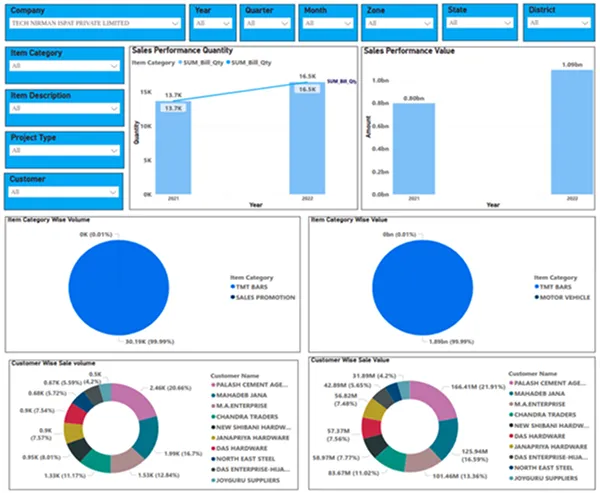
1. Sales Performance – Volume (Year / Quarter / Month wise quantity)
Challenge:
Manufacturing companies often lack clear visibility into how many units are being sold over different time periods.
Objective:
Detect seasonal demand patterns, plan production schedules accurately, or respond to sudden changes in market demand.
Resolution offered:
- Tracking sales volume by selected time period criteria
- Helps identify peak sales periods, supports inventory control.
Criteria: Customer
2. Sales Performance – Value (Year / Quarter / Month wise amount)
Challenge:
Without tracking revenue trends over time, manufacturers struggle to evaluate financial performance, spot growth or decline periods, and make timely strategic decisions.
Objective:
Timely revenue reporting that will positively impact budgeting and investment planning.
Resolution offered:
- Time period based revenue tracking provides immediate insight into sales performance
- Supports quick executive decision-making, helps assess the effectiveness of pricing strategies
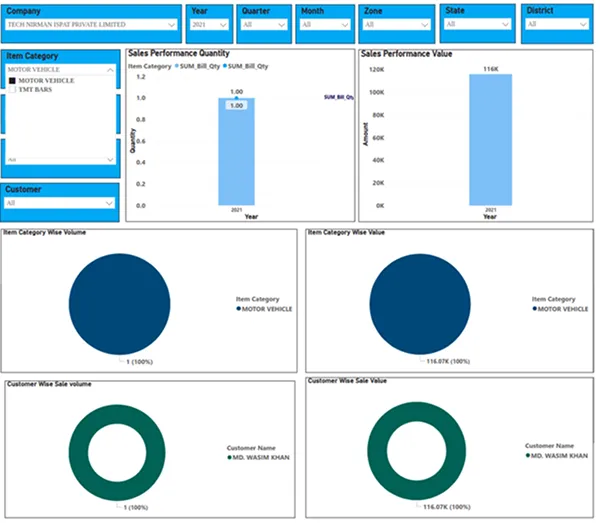
3. Item Category Wise – Volume (sales quantity)
Challenge:
Manufacturers often lack clarity on which product categories are in demand
Objective:
Efficient resource allocation, avoid overproduction of low-demand items or underproduction of high-demand ones.
Resolution offered:
- Volume tracking by item category revealing which product types are in highest demand.
- Optimise production, manage inventory levels, and prioritise marketing and distribution efforts for fast-moving goods.
Criteria: Item Category
4. Item Category Wise – Value (sales amount)
Challenge:
While some items sell in large volumes, they may not contribute significantly to revenue.
Objective:
Develop value-based insights by category, so that businesses do not risk focusing on the wrong products or miss opportunities to boost profits.
Resolution offered:
- Analyzing sales value by item category so that manufacturers can identify the most profitable product lines.
- Supports better product mix decisions, pricing strategies, and prioritization of high-value offerings.
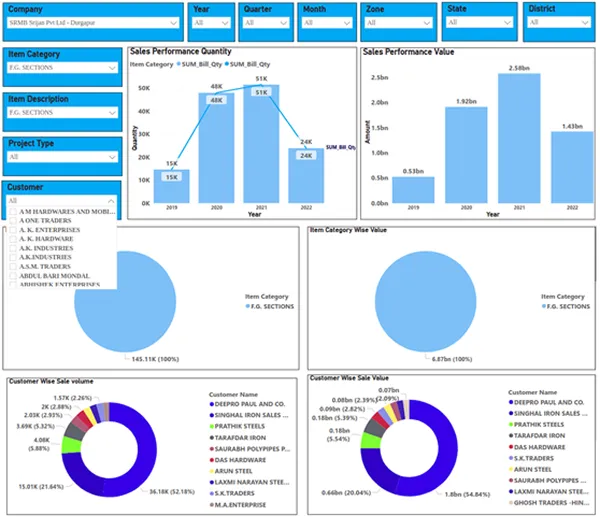
5. Customer Wise Sales – Volume (quantity)
Challenge:
It’s often unclear which customers purchase the highest quantities.
Objective:
Order planning, customer relationship management, and avoid lack of prioritisation in service levels to important customers
Resolution offered:
- Tracking sales quantity per customer highlighting major volume buyers.
- Better segmentation, improved delivery planning, and targeted engagement for operational efficiency and customer satisfaction.
Criteria: All Customer, Item Category
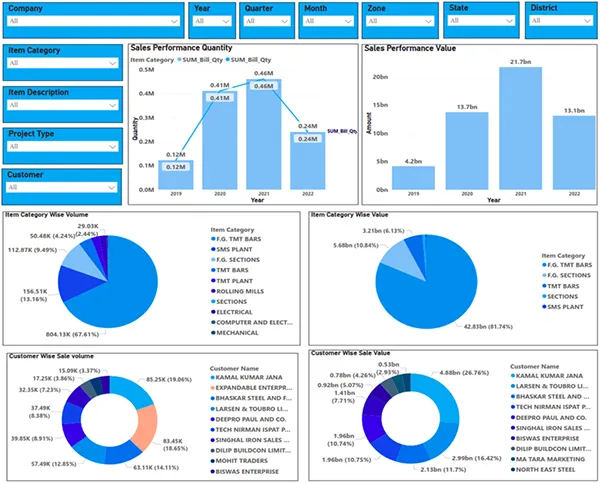
6. Customer Wise Sales – Value (amount)
Challenge:
Manufacturers may rely heavily on a few high-value customers without realizing the extent, exposing the business to revenue concentration risks.
Objective:
Avoid lack of visibility into customer value which weakens retention strategies.
Resolution offered:
- Value-based customer analysis identifying top revenue contributors and potential churn risks
- Supports account-based strategies, helps mitigate over-dependence on specific clients, and enhances revenue forecasting.
Criteria: Master Dashboard
Case Study Nine
QBot – AI-driven Conversational Chatbot for Enhanced Customer Experience
- Sector: Customer Engagement & Support
- Solutions: AI ChatBot for Personalised Customer Experience and Automation
- Deployment: Cloud-based with Web & Third-Party Integrations
1. Assessment & Vision Setting
Current State Analysis –
Businesses face challenges in creating quick customer touchpoints, offering personalised conversations, and enabling live agents with enough context to resolve issues on the go. Manual customer care operations and generic chatbots lacked intelligence and adaptability.
Defined Objectives –
- Automate first-level customer interactions
- Personalise conversations to improve engagement
- Reduce load on live agents with contextual handovers
- Enable seamless support across multiple business verticals
Stakeholder Alignment –
Collaborated with Customer Service, Sales, and IT teams to define conversational flows, integration points, and escalation rules.
2. Process Reengineering
Mapped Existing Workflows –
- Manual handling of FAQs and lead qualification
- Service ticket creation via email/phone support
- E-commerce support is managed through multiple disconnected channels
Redundancy Elimination –
- Automated FAQ resolution and ticket generation
- Integrated lead qualification into chatbot conversations
- Unified e-commerce assistance through a single interface
Standardised Procedures –
- Conversational flows documented for each use case: Customer Care, Lead Generation, Ticketing, and E-commerce.
- Rules established for escalation to live agents with full context.
3. Technology Transformation
- Cloud Deployment – QBot is deployed as a scalable, cloud-based chatbot with role-based access and API-driven integrations.
- AI/NLU Layer – Powered by BERT Transformer models for contextual understanding and personalised responses.
- Backend Services – Built on Node.js and PHP for speed, flexibility, and easy integration.
- Web Frontend – Developed using AngularJS and JavaScript to deliver responsive, real-time interactions.
- Third-Party Integrations – Google Text-to-Speech and Speech-to-Text enabled natural voice interactions for enhanced accessibility.
4. Automation & Self-Service
- Customer Care – Instantly responds to FAQs, billing queries, and service requests.
- Lead Generation – Engages prospects with contextual questions, qualifies leads, and syncs data with CRM.
- Service Ticketing – Automatically generates and routes tickets to the right department, reducing turnaround time.
- E-commerce Assistance – Guides users with product discovery, order tracking, and personalised recommendations.
5. Data & Insights Activation
- Analytics Dashboards to track interaction volumes, resolution rates, and escalation trends.
- Conversation Logs & Reports provide insights into customer intent, improving business decision-making.
6. Governance & Compliance
- Secure role-based access for chatbot configuration and logs.
- GDPR-compliant data handling for customer interactions.
7. Continuous Improvement
- Feedback Loops enhance chatbot intent recognition with each customer interaction.
- Scalable Framework allows expansion into new domains and languages without major redevelopment.
Outcome
- 65% reduction in first-level support queries handled by agents
- 50% faster resolution time for service tickets
- Increased lead capture rate by 40% through chatbot-driven engagement
- Improved customer satisfaction scores with personalised, AI-driven conversations
Case Study Ten
Digital Transformation Process for a CRM (Customer Relationship Management)
tailored for businesses modernising customer interactions, sales, and support workflows:
Product: AI driven Adaptive Sales management platform for any sales driven businesses
1. Define the Vision & Business Goals
Clarify Objectives
- Improve customer acquisition & retention
- Streamline sales pipeline
- Enable personalised engagement
- Unify customer data across channels
Stakeholder Involvement
- Involve Sales, Marketing, Support, and Internal IT Team
2. Audit Existing CRM Capabilities
- Gap Analysis Review legacy CRM tools (e.g., spreadsheets and internal software)
- Data Mapping Identify fragmented data sources, inconsistencies, and ownership
- Evaluate User Adoption Check pain points for sales reps, marketers, and customer agents
3. Deployed the Right CRM Platform
- Cloud-Based Choose platforms as Custom SAAS Product
- Scalability & Integration Ensure compatibility with ERP, email, social, website, and mobile apps
- Customisation & Automation Capabilities Considered low-code/no-code workflow processes
4. Data Migration & Unification
- Cleanse Customer Data Remove duplicates, validate emails/phones, normalise fields
- Merge Disparate Systems Integrate old databases, Excel sheets and imported data from third-party apps
- Set Master Data Model Ensure consistency across departments
5. Automate and Personalise Workflows
- Lead & Opportunity Management Automate lead scoring, assignments, and reminders
- Sales Automation Streamline follow-ups, quote generation, and order generation
- Marketing Automation Drip campaigns, behavior-based email triggers, CRM-integrated newsletters
- Customer Support Auto-create tickets from emails, assign priorities intelligently
6. Enable AI & Analytics
- Customer 360° View Combine purchase history, support touchpoints
- Predictive Sales Insights Use AI to suggest high-likelihood conversions
- Churn Analysis Flag at-risk customers and suggested proactive engagement
7. Multi-Channel Customer Engagement
- Omnichannel Integration Integrated email, WhatsApp and social media
- Self-Service Portals Let customers view order status and raise tickets
- Chatbots & Conversational AI First-line query handling and lead qualification
8. Governance, Security & Compliance
- Access Control & Data Privacy Implement role-based access, encryption, and privacy policies
- Audit Trails Track every modification in customer records
9. Training, Change Management & Adoption
- User Training Programs Hands-on training, quick guides
- Internal Champions Nominate power users to drive adoption
- Feedback Mechanisms (Manual) Continuous loops to improve usability and workflows
10. Continuous Optimisation
- KPI Dashboards - Revenue, pipeline health, lead conversion, response time
- Customer Feedback Analysis -Used real data to evolve CRM interactions
Add-ons done :
- Mobile CRM App for field sales
- Gamification to motivate sales teams